5.15.2013

Steam Baths Act 5 -- Site and Design


 --
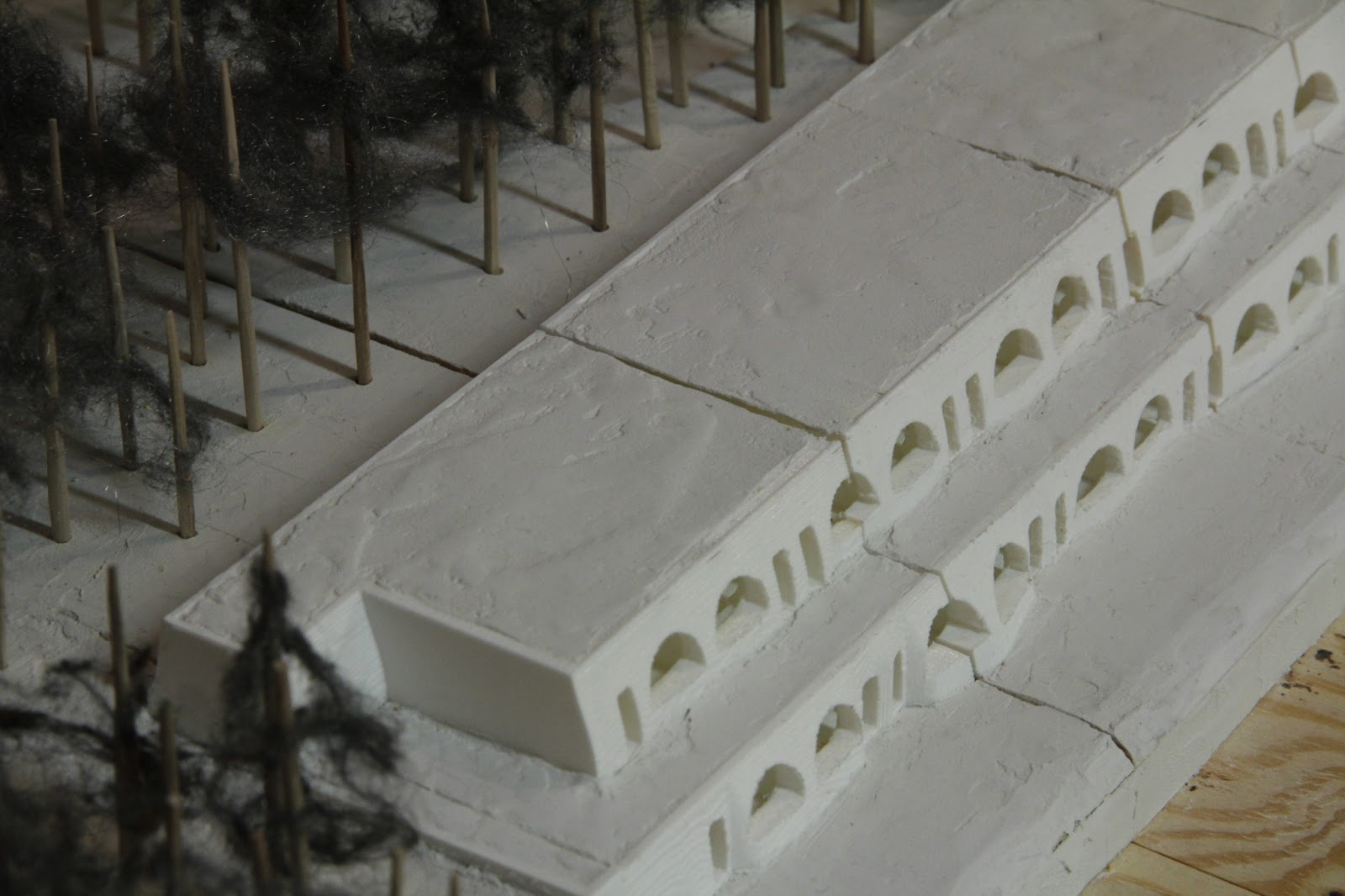
The Steam Bath’s entrance dips beneath the earth like the act of bathing. The underground parking baths the guests with light through the direct lightwells above. The noise from highway 61 is impeded by the curb-hill, low vegetation, tall trees, earthen-roof and lightwells. The site becomes quiet and calm. Only the sounds of lapping water and laughing guests are heard from the site.

To heat the structure the medieval kachelöfen is used. An intuitive system harnessing wood for a fuel source. After an hour of burning a log the oven is shut-off but will continue to heat the room for another twelve hours because of its channelled chimney. The oven is very efficient, using one log per year (6m3). The intuitive system uses radiant heating which warms the surrounding timbrel vaults rather than air. So, venting does not remove heat but rather only stale air within. The Steam Baths essentially become a giant oven stove.

--

5.03.2013

Steam Baths Act 4 -- Building a Narrative


--
Standing before a cold and heartless night, a position for the ‘hearth’ is confidently and delicately chosen. The fire is suddenly ripe with delight. The unhurried process of burning transforms the haunting of ‘ghoulish effigies’ into their former selves: trees and bugs. A night of survival is for the brave and practical. One must instinctually perform to stay alive and build a home where no civilization exists. My great yearning for the outdoors has left me with a high level of sympathy towards the innate habits which all humanity unconsciously embraces. These are the impulses our ancestors used to survive and craft the world around us.

Unfortunately, today we act without instinct and indeed we express this issue in our architecture: denial of the senses, loss of context, little purpose, refusal of higher meaning and no intuitiveness. Our priorities have switched gears towards the philosophies of technology forgetting that architecture and science should never be separated. We have become a counter-intuitive society without purpose. We erect oversized boxes which deny our human scale and habits. We are physiologically and mentally taxing humanity.

Conveniently, a simple examination of our primal to modern lives will provide the answer to this deep crisis. The innate habits we use everyday is the key to intuitive architecture. With purpose comes intuition. We all crave architecture that provides our senses with an immersive experience. Therefore, the bathhouse—an ancient typology—will be an example to root our designs.

Suitably, the majestic Lake Superior brings all to their knees with the frigid blue water. After one long and arduous journey in the woods, I was left dirty, hot and irritated. The smell of the lake seasoned in the heavy winds of summer drew me quickly. I saw sharp splendor as I gazed upon the vast expanse of the horizon. I slowly submerged myself into the tranquil lake. My muscles tensed, my body paralyzed and my mind became hypersensitive. I practiced the purification of ablution which primordial cultures traditionally invoked. The Bathhouse embodies this experience and provides a rest from our counter-intuitive architecture of today.
Palisade Head and Lake Superior convene at the edge of a primordial landscape. Rock and debris are indomitable apart from the sharp, blue waters. Nothing escapes Lake Superior. The bath house so instinctually connects with the interaction between land and water that Lake Superior becomes a principal example. The protruding shelf of Palisade Head interrupts the rhythms of the water like a colossal man entering a wave. The site views this natural event over the course of the harsh year.

Providentially, because the cliff side is connected to a public lake, the Bathhouse once more intuitively unites the site. Seriously taking into account the private versus public land, this public typology will not take away a resource that we so dearly need but rather invites public participation with nature. The significance of the bathhouse on this cliff allows the public to make use of an unused landscape. Currently, this terrain in uninhabited but through propagation and acoustic dampening, the site will enliven the North Shore—as if Lake Superior was never whole without the Bathhouse.

--excerpt: A Need For a New Desire 
Masters Thesis by jeremiah i. johnson
--

4.17.2013

Steam Baths Act 3 -- Principles of Intuitive Design


--
Principle Two:
the body

A chair, a handle and a door all possess a profound commonality. As simple as it may seem, each object bears a relation to our body. The chair is designed for our posterior to rest upon. The handle is for our hand to grasp. The door is a puncture for our body to pass through a wall. This deep perception into our built environment is sensationally important to the design of architecture. Without it, we could not craft. We have learned through creation that intuitive design is based on the human body. The speed we walk determines a distance. The height of our head determines how tall a ceiling should be. The placement of a light switch helps us in the dark. So, the old maxim, the world does not revolve around you; may not be entirely true. For the built environment is designed with one purpose: to exist for humanity.

Perpetually, our constructed environment resides within this tactile world. It is a world of the human body. Every shape, form, space and quality affects the way we related our body to this world. For illustration: A low-hung tree makes us duck, a vast cathedral causes us to look up or a long railroad track projects us into a vast horizon. We see the world relative to our form. Look around the room. Each object, material or placement connects us to our architecture. The body bridges that gap between an unknown mystery and the familiar. Unfortunately, today many objects once designed for the body now have degraded into a detail-less form that speaks not of our bodily construction. Everything has become flat and tactileless.

--excerpt: A Need For a New Desire 
Masters Thesis by jeremiah i. johnson
--

3.05.2013

Steam Baths Act 2 -- A Need for a New Desire


--
"An Abstract
Today, architecture constitutes the greatest range of the built environment; yet our buildings are causing physiological and mental stress to the public. If architecture is designed intuitively by engaging the public’s senses through innate habits, we can reduce the stress caused by ‘counter-intuitive’ design and delight the guests. This Thesis explores ‘intuitive design’ through an ancient typology—the bathhouse—built cliff-side of Lake Superior in Northern Minnesota. By utilizing the concurrent transformative mixed research method, qualitative and quantitative data will present a cohesive analysis to complete the architecture.


Key Words: Intuitive Architecture, Purposeful Design, Public Space, Ethics, Senses, Habit, Memories, Connotation"


"I
Today, we stand before a catastrophic threshold. A majority of our built environment has thrown-out meaningful design and replaced the collection with efficiency. Our priorities care neither for the individual nor quality; rather we abide in amount, money and haste. We squeeze employees into small lifeless cubicles where job focus becomes null. Efficiency has been crowned King. The trademark of our modern job atmosphere is a gloomy, isolated, dry-walled and uniformly lit space. As Juhani Pallasmaa, a critical architect of the 20th century exposes, “An efficient method of mental torture is the use of a constantly high level of illumination that leaves no space for mental withdrawal or privacy” (J. Pallasmaa, 2012, p.51). These cubes may save us a few dollars now, but will eventually wound our spirit and weaken our fortitude. Architecture today is the craft of costly warehouses and we are its storage. Therefore, we must acknowledge the
emergency and take action... "


"II

The genesis of intuitive architecture is purpose. The word intuitive refers to the perception of truth. That which is felt to be true without reasoning or logic is intuition. Purpose then, refers to a meaningful form or design—something that is practical and particular. We understand intuitive design through our senses. These built-in traits which all humanity possesses construct a repertoire of instinctual actions. When we were young, we never sensed high temperatures and in consequence we burnt ourselves. Suddenly, we intuitively know when something nearby is hot through our senses. Intuition allows habits to form which ultimately ease our over-stimulated mentality. Thus through the senses, innate habits allow for intuitiveness to blossom. Regrettably, our architecture today causes bad habits to form. Furthermore, intuition perhaps refers to the ease of some activity. While this certainly seems true, it is somewhat skewed. Because intuition is the perception of reality rather than a logical understanding, we find that ease or hardness is only a matter of the latter. On the other hand something that is intuitively understood suddenly becomes easy because little conscious thought is needed to understand the idea: it is instinctual. So like the old adage, a square is a rectangle but a rectangle is not a square, the same holds true here. Intuitive architecture is easy for the guest but ease is not intuitive for it is not instinctual but rather logical..."


--excerpt: A Need For a New Desire 
Masters Thesis by jeremiah i. johnson
 --

2.11.2013

Steam Baths Act 1 -- Architecture and the Intuitive

The Cover


--
In a vast cosmos of perpetual surroundings, our built environment triumphs as an utterly inspirational and damning phenomenon. The cold touch of concrete, the mystery of shadow or the fragrance of age penetrates our every memory. Each architectural nuance influences our human character. The sensitivity to our corporeal senses perceives rhythms in our imagination. Ethically, we must evolve our awareness to the built environment, for architecture is more complex than the mere geometrics or the visual extraordinaire that we initially presumed. It is a passive entity heralding delight or dominating mankind.

But is architecture truly static or can it be an event?
--